
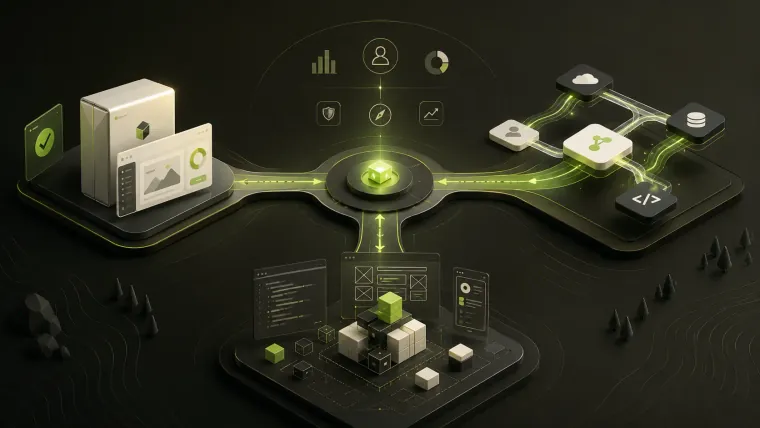
Every time a company faces a software need, there are three paths: buy an existing solution, integrate tools already in use, or build something custom. The wrong answer usually comes from optimizing the decision by the wrong criterion.
When does buying make sense?
Buying makes sense when the problem you want to solve is not differentiating for your business. An invoicing system, a CRM or accounting work the same way as at any other company in your industry, so there is no reason to build them from scratch. Buying a mature solution is cheaper, faster and carries lower failure risk.
Market trends confirm that buying or integrating tends to be the default path: Gartner projects that by 2026, 75% of new enterprise applications will be built on low-code platforms, up from less than 25% in 2020 — building everything from scratch is increasingly the exception, not the rule.
Do not build what you can buy. Do not buy what defines how you are different.
When does integrating make sense?
Integrating is the most underrated option, and it is often the most relevant one for agriculture or logistics companies that already have an ERP, a fleet management system (TMS) or a warehouse management system (WMS), but run them in silos. Connecting that system to accounting, automating data handoffs between platforms or building a panel that consolidates scattered information can create more value than any build-from-scratch project.
When does building make sense?
Building makes sense when the process you want to digitize is genuinely different from your competitors and that difference creates value — a proprietary batch-traceability logic, a routing algorithm tuned to the real geography of your operation. Also when you need full control over the system evolution, or when long-term licensing costs exceed the cost of building and maintaining something custom.
What is the everything-custom trap?
Some companies build everything: their own CRM, their own project tool, their own ticketing system. This concentrates dependency on the technical team, makes onboarding new people harder and generates maintenance debt that grows over time. Custom software needs a strategic reason to exist.
How to structure the decision
Is this process part of how we are different? If yes, build. If not, do we already have a tool that can handle it? If yes, integrate. If not, buy the simplest one that meets the need and re-evaluate in twelve months.